Greenway Institute Plans New College Model
A coalition of leaders is launching the Greenway Institute in Vermont, a new engineering college focused on hands-on projects and work placements to lower costs.
Greenway Institute is planning a new college in Montpelier, Vermont, to reinvent higher education. Business, college, and government leaders aim to strip away expensive amenities and bureaucracy while emphasizing proven instructional methods like faculty-mentored, real-world training.
Mark Somerville, the founding president and former provost of Olin College of Engineering, said this effort comes during a period of significant challenge for colleges. He argues this makes the need for new models clearer than ever. In Vermont alone, seven private colleges have closed in the last decade.
The Future Universities Alliance
The Greenway Institute is part of a broader movement. Several experimental higher education institutions in planning stages were organized in January by Duke University into a Future Universities Alliance. Another member is Project Polymath, founded by Dan Futrell, former CEO of the Pat Tillman Foundation.
Project Polymath proposes to mentor bachelor's degree students through three different majors each starting in 2028, followed by two-year employer apprenticeships. It calls itself an ROTC for the private sector.
Brian Rosenberg, former president of Macalester College and a member of advisory boards for both Greenway and Polymath, said there is broad agreement that something has to change. He noted that changing legacy institutions from within is agonizingly difficult and these new projects are an alternative approach.
Greenway's Model and Progress
The institute purchased its campus in 2023 from the Vermont College of Fine Arts, which had mostly gone remote by then and would be acquired a year later by the California Institute of the Arts after enrollment declines and multimillion-dollar deficits. After many renovations, it tentatively plans to open next fall. The school has raised $4.5 million toward a goal of $30 million by 2031, according to Somerville. This includes a National Science Foundation grant shared with partner institution Elizabethtown College in Pennsylvania. It's also making money by renting out space it doesn't need.
Founders and advisers include tech executives, CEOs, a former Vermont state secretary of education, a NASA engineer, and administrators from schools like Harvard and Dartmouth. It will teach only engineering.
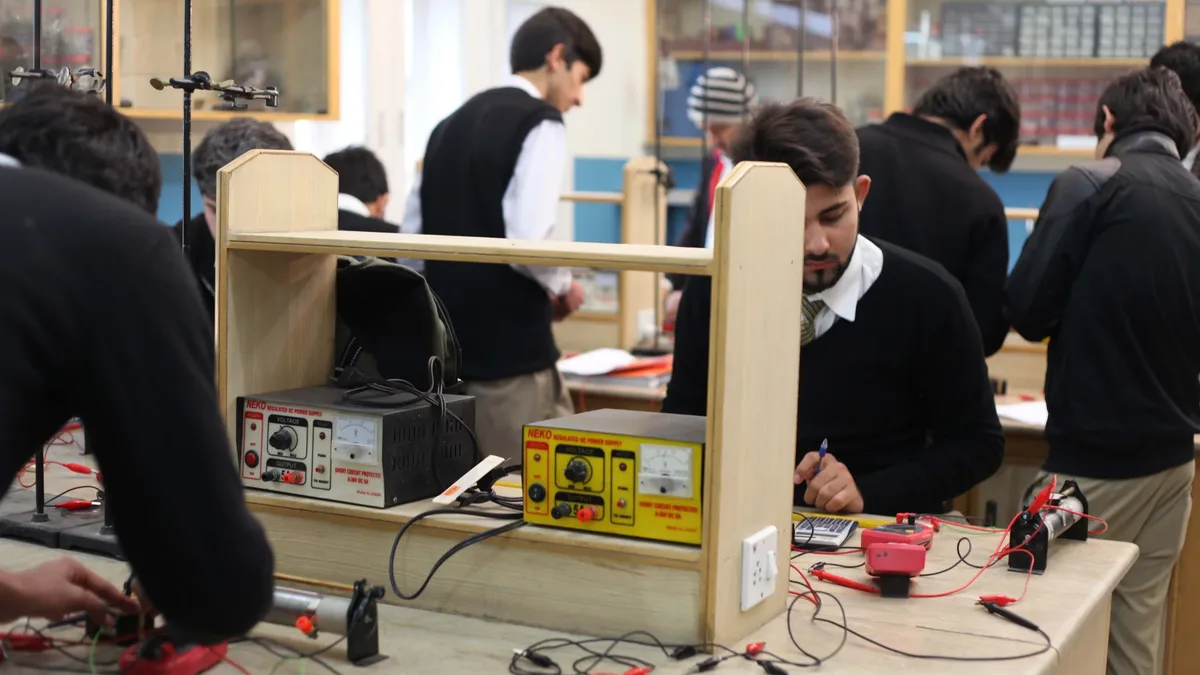
The project already tested its model last year on a group of students borrowed from other schools, which gave them academic credit for coming to the Greenway campus and doing hands-on work with faculty supervisors in a prototype semester. Instead of conventional lectures, students designed wind turbines and solar-powered traffic signals. Troy McBride, chair of Greenway's board and co-founder of a solar panel manufacturer, said they basically learned electrical, mechanical and some controls by doing.
New research from the University of Wisconsin-Madison and the Strada Education Foundation shows work-based learning improves job prospects, career advancement, and earnings. However, a separate Strada study found fewer than half of students at public four-year universities experience paid work-based learning.
A Lean Operational Philosophy
When fully operational, Greenway students will live on campus for two years doing projects, then spend two more years in real-world workplaces while receiving faculty support. This lowers the college's housing costs. Students will also shop and cook for themselves in communal kitchens and plan their own extracurricular activities.
Research cited by the Association of College and University Housing Officers indicates students living on campus for the first two years benefit from a communal setting and have lower dropout rates. Somerville noted that by junior year, many students are ready for experiences like studying abroad.
The model intentionally avoids expensive amenities. Jazz Gonzalez, an Elizabethtown graduate who participated in the prototype, said not having climbing walls or football games really didn't matter to them. A McKinsey study found that in the decade before the pandemic, spending on noninstructional services at colleges grew four times faster than spending on instruction.
Annick Dewald, Greenway's first faculty member, said making students responsible for cooking and scheduling teaches vital life skills. She said employers have told her the hardest thing about fresh-from-college undergrads is getting them to show up on time or sleep eight hours at night or to figure out how to feed themselves.
Hannah Root, the project's chief of staff, said taking the test students food-shopping was one of the most challenging moments of the prototype semester.